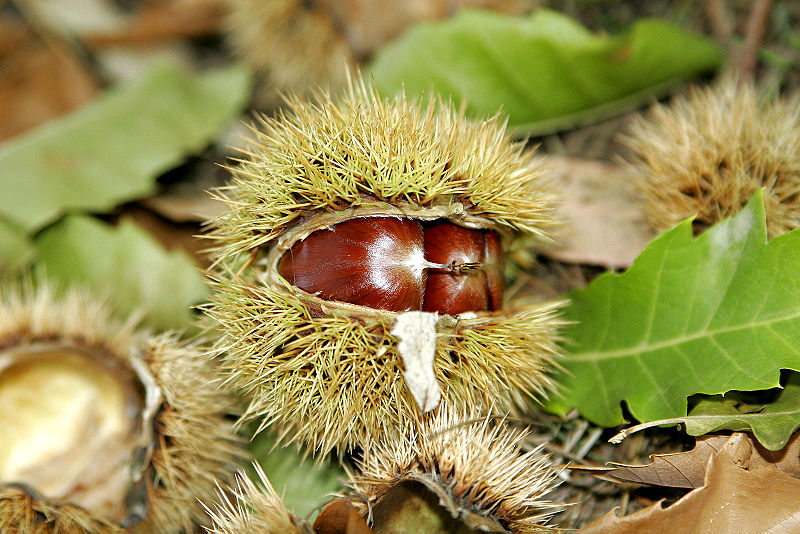
Chestnut (Castanea), some species called chinkapin or chinquapin, is a genus of eight or nine species of deciduous trees and shrubs in the beech family Fagaceae, native to temperate regions of the Northern Hemisphere. The name also refers to the edible nuts they produce.
Etymology
The name
Castanea is probably derived from the old name for the Sweet Chestnut, either in
Latin or in
Ancient Greek. Another possible source of the name is the town of Kastania in
Thessaly, Greece
; but it is more probable that the town took its name from the most common tree growing around it.
Among the Mediterranean climate zone, chestnut trees are rarer in Greece because the chalky soil is not conducive to the tree's growth. Kastania is located on one of the relatively few sedimentary or siliceous outcrops. They grow so abundantly there, that their presence would have determined the place's name.
Still others take the name as coming from the Greek name of Sardis glans (Sardis acorn) –
Sardis being the capital of
Lydia, Asia Minor, wherefrom the fruit had spread.
The tree's names are virtually identical in all the most ancient languages of Central Europe: in Breton
kistinen for the tree, and
kistin for its fruit, in Welsh
castan-wydden and
sataen, in Dutch
kastanje for both the tree and its fruit, in Albanian
gështenjë, and many others close to the French
châtaigne and to the Latin name chosen for the genus.
The name is cited twice in the
King James Version of the Bible. In one instance, Jacob puts peeled twigs in the water troughs to promote healthy offspring of his livestock.
Although it may indicate another tree, all indicates that that fruit was a local staple food at that time.
The following
synonyms are or have been in use:
Fagus castanea (used by Linnaeus in first edition of
Species Plantarum, 1753).
Sardian nut. Jupiter's nut. Husked nut. Spanish Chestnut (U.S.).
 |
| Chestnuts can be found on the ground around trees |
Nutrition
Fresh chestnut fruits have about 180
calories (800 kJ) per 100 grams of edible parts, which is much lower than
walnuts,
almonds, other nuts and dried fruit (about 600 kcal/100 g).
Chestnuts, as with all plant foods, contain no
cholesterol and contain very little fat, mostly unsaturated, and no
gluten.
Their carbohydrate content compares with that of wheat
and rice; chestnuts have twice as much
starch as the potato.
In addition, chestnuts contain about 8 percent of various
sugars, mainly
sucrose,
glucose,
fructose, and, in less amount,
stachyose, and
raffinose In some areas, sweet chestnut trees are called "the bread tree".
When chestnuts are just starting to
ripen, the fruit is mostly starch and is very firm under finger pressure from the high water content. As the chestnuts ripen, the starch is slowly converted into
sugars; and moisture content also starts decreasing. Upon pressing the chestnut, a slight 'give' can be felt; the
hull is not so tense, and there is space between it and the flesh of the fruit.
The water is being replaced by
sugars, which means better conservation.
They are the only "nuts" that contain
vitamin C, with about 40 mg per 100 g of raw product, which is about 65 percent of the U.S.
recommended daily intake. The amount of vitamin C decreases by about 40 percent after heating. Fresh chestnuts contain about 52 percent water by weight, which will evaporate relatively quickly during storage; they can lose even 1 percent of weight in one day at 20 °C and 70%
relative humidity.
Tannin is contained in the bark
as well as in the wood, leaves and seed
husks. The husks contain 10–13% tannin.
 |
| Chestnuts |